Whose number is this?
By the StoryCheck team · 6 min read · Published August 18, 2026
Working out whose number is calling takes three steps: read the area code, search the number properly, and use a reverse lookup for the part that is not public. Most unknown numbers resolve within a few minutes that way, and the person holding the number never finds out you looked.
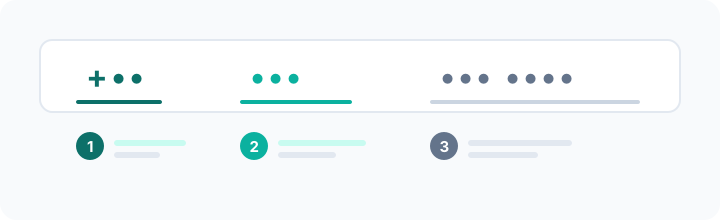
Fastest order: search the number in quotes first, then check messaging apps for a profile photo, then run a reverse lookup for whatever is still missing.
Search the number in quotes
Put the whole number in quotes in a search engine, for example "416 555 0134", and try it with dashes as well as without. This works better than people expect for businesses: contractors, clinics and small operators publish their numbers on their own sites and in listings. If it is a business number, the answer is usually in the first few results.
Read the area code, and know its limit
The area code gives you a region: 416 and 647 are Toronto, 604 and 778 are Vancouver, 403 is Calgary, 902 is Nova Scotia and PEI. What it cannot give you is the line type. Canada has no separate cell ranges, so a 416 number may be a landline, a cell or a VoIP line, and that distinction is usually the one that matters. Overlay codes are also not a signal: 437 covers the same ground as 416, and a newer code does not mean a less legitimate caller.
Check messaging apps
Save the number to your contacts and open WhatsApp or Messenger. Many profiles show a photo or a display name to anyone who has the number saved. A face is often enough, because you can then search the image and find the same person elsewhere. Caller ID apps can help, but their names come from other users' address books, so they can be wrong, stale or deliberately misleading, and they are not proof.
Run a reverse lookup
Canadian cell numbers appear in no open directory, and the number you most want identified is almost always a cell. A reverse lookup cross-references licensed telephony data with open sources: likely owner, region, carrier, whether the line is a real cell or a VoIP number, linked public profiles and known scam signals. The report is private and takes about 60 seconds.
A verified checkmark on an incoming call comes from STIR/SHAKEN and only means the number was not spoofed. It is not a judgment about the caller.
The honest limits
Nothing can conjure a name from a number the owner has never used anywhere. Results are possible matches with a confidence level, not guarantees. But the area code, a proper search, a messaging app check and a reverse lookup together resolve the large majority of unknown numbers well enough to decide: call back, block, or ignore. If the same number keeps calling, who keeps calling me carries on from here.
| Number starts with | What it means | What to do |
|---|---|---|
| 416 / 647 / 437 | Toronto. Overlaid codes covering identical ground. | A newer code is not a warning sign in itself. |
| 604 / 778 / 236 | Vancouver and the Lower Mainland. | The region should match what the caller tells you. |
| 613 / 343 | Ottawa and eastern Ontario. | Worth noting if the caller claims to be a federal department. |
| 867 | Yukon, Northwest Territories and Nunavut. | A single code for all three territories. |
| 800 / 833 / 844 / 855 / 866 / 877 / 888 | Toll-free. | Calling back costs nothing. Verify on the official site. |
| 900 | Premium rate. | Never call back a 900 number you did not start. |
| Any code at all | Cannot tell you cell, landline or VoIP. | Only a line-type check distinguishes them. |
Common questions
Can I find out whose number it is for free?
Sometimes. Searching in quotes and checking messaging apps costs nothing and works well for businesses. Personal cell numbers usually need the licensed data a reverse lookup uses, because they are in no open directory.
Will they know I checked?
No. Neither searching, nor checking a messaging app, nor running a reverse lookup sends any notification to the person holding the number.
Does the area code tell me if it is a cell phone?
No. Canada does not separate cell and landline ranges, so the same area code covers both, plus VoIP numbers. Only a line-type check tells them apart.
Related guides
Find out who is really behind the number
The check is private and takes about 60 seconds. The person is not notified and never finds out you looked.
Check a number now